
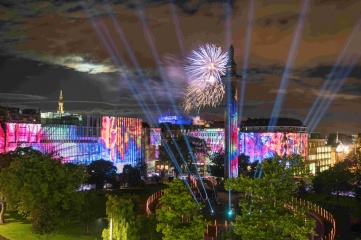
Following Glasgow's successful hosting of the 2026 Commonwealth Games, attention now turns to Edinburgh, where the city's internationally renowned festivals are set to welcome artists and audiences from around the world. Recent research from Festivals Edinburgh highlights the wider impact of the Festivals as a major cultural, social and economic asset for Scotland as a whole.
The report, The Impact of the Edinburgh Festivals, draws on a series of cultural, social and economic indicators and concludes that the Festivals “make life better” for residents, artists, visitors and businesses.
Among the key findings, the research identifies the Edinburgh Festivals as a unique civic asset that enhances wellbeing through creative and community engagement, provides an international platform for Scottish artists and companies, and strengthens Edinburgh’s appeal as a place to live, work, visit and invest.
The study highlights that 90% of audiences regard the Festivals as unique places of cultural discovery, while 79% of local audiences say the Festivals make Edinburgh a special place to live.
The Festivals are also identified as a significant contributor to Scotland’s creative economy, spending more than £10 million annually with event production companies and creative talent based in Scotland. The research calculates that the Festivals could generate a gross economic impact of £4.26 billion over the next five years in Scotland.
“Cultural beacons”
Professor Daisy Fancourt, University College London Director, WHO Collaborating Centre on Arts and Health and UNESCO Chair in Arts & Global Health, wrote in the report’s foreword that the Edinburgh Festivals “have long stood as one of the world’s most remarkable demonstrations of the power of arts and culture.”
“Every year, Edinburgh becomes a meeting place for creativity, curiosity and connection, welcoming artists and audiences from across Scotland and around the globe for a mesmerising array of artistic experiences,” she said.
Professor Fancourt said the significance of the Festivals extends beyond performances and exhibitions, highlighting their role in strengthening communities, supporting wellbeing and contributing to Scotland’s cultural identity.
“The evidence is now clear that arts and cultural participation are not optional extras or luxuries in our daily lives, but instead fundamental pillars of individual health and wellbeing,” she said.
The report also highlights the Festivals’ international role as a platform for artists and a driver of cultural tourism, while recognising their contribution to Scotland’s global reputation.
Professor Fancourt described the Edinburgh Festivals as “cultural beacons”, noting that they are “inherently place-based – woven into the social fabric of Edinburgh as a city – yet deeply connected nationally and internationally.”
As Edinburgh approaches the 80th anniversary of the birth of its world-leading festival city in 2027, the research provides further evidence of the role the Festivals play in Scotland’s cultural and economic future.
“The Edinburgh Festivals show what is possible when culture is placed at the heart of civic life,” Professor Fancourt concluded. “This report provides a powerful case for the importance of sustaining and investing in their future for generations to come.”
World leading destination
The Edinburgh Festivals represented in the Impact Study are Edinburgh Science Festival, Edinburgh International Children's Festival, Edinburgh Jazz & Blues Festival, Edinburgh International Festival, Edinburgh Festival Fringe Society, the Royal Edinburgh Military Tattoo, Edinburgh Art Festival, Edinburgh International Book Festival, Edinburgh International Film Festival, Scottish International Storytelling Festival and Edinburgh's Hogmanay.
Collectively, the Festivals constitute one of the world's largest annual programmes of cultural events, attracting audiences on a scale comparable to a FIFA World Cup or Olympic Games, demonstrating how a city can successfully host multiple world-class events year after year.
This year's Edinburgh Festival Fringe features 3,649 shows from 71 countries across 258 venues, comprising almost 54,000 performances. In 2025, the Fringe sold more than 2.6 million tickets, making it the world's largest performing arts festival.
Coming immediately after Glasgow's hosting of the Commonwealth Games, the 2026 festival season further demonstrates Scotland's ability to stage major international events across both sport and culture. Together, Glasgow and Edinburgh showcase the country's depth of hosting capability and reinforce its reputation as one of the world's leading destinations for major events.
