
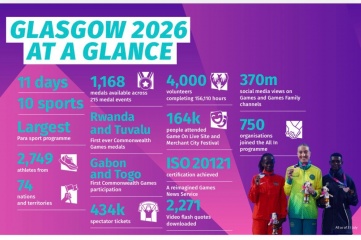
One of the world’s foremost events experts has hailed the game-changing legacy that will be left behind by the Glasgow 2026 Commonwealth Games, providing a blueprint for the delivery of future instalments of the competition as well as other major events.
James Bulley OBE, co-founder of Trivandi, the event delivery partner for Glasgow 2026, said this summer’s biggest sporting event in the UK had demonstrated how major events can be delivered differently to reduce the barriers for future hosts.
A leading British sports events executive best known for his senior role in delivering the London 2012 Olympic and Paralympic Games, Bulley served as Director of Venues and Infrastructure from bid stage to delivery. He advises governments, organising companies, and sports bodies around the world on venue strategy, operational planning, and large‑scale event delivery, and was awarded an OBE for services to the London 2012 Games.
A successful new delivery model
Glasgow was confirmed as the host city for 2026 after Victoria, Australia, had to drop out, leaving just 18 months to organise an event which normally has a lead-in time of around five years. That was possible because Commonwealth Sport developed a reimagined Games model, which demonstrates a more flexible, sustainable, and partnership-led approach. This has enabled the Glasgow 2026 organising company to stage the Games on a shorter timeline and a smaller budget.
That meant the model for delivery of the event had to be adapted in a number of ways, and one of the key differences with previous Games for Glasgow 2026 was the introduction of an event delivery partner, embedded within the organising company. Trivandi was appointed to that role around 400 days before the event began.
James Bulley OBE said: “It’s the first time an event of this scale has been held with so little time to prepare and with a budget considerably lower than previous Games. But if you watched it on TV, walked through the venues and saw what was delivered, it did not feel like anything other than what you would expect at a major event. Everything has been to the same quality and level of higher budgets and longer lead-in times – and maintaining sports presentation has been key to that.
“The embedded event partner model created a genuine one-team environment, with Glasgow 2026, Trivandi, and all stakeholders working side-by-side throughout. Everyone has worked together as a true partnership to overcome the challenges that come with any major event and focused on getting the job done. From the point of view of bringing together hundreds of people in short order to deliver a world-class event, working with a shared mindset, Glasgow 2026 has been a great success.”
A human legacy
To support the delivery of the Games, last August Trivandi began the process of hiring 250 people, with a commitment to recruiting more than half of the team from Glasgow and its surrounding areas. In addition, it helped provide formal, structured training to the organising company’s 700 staff and the Games’ 3,000 volunteers through its Trivandi Academy.
James Bulley OBE said: “The human legacy of the Games is one of the most important aspects of delivery. We firmly believe major events should be delivered by local people – even if they have no experience of working in the sector. That has meant a big commitment to training and development, but it has worked really well, with the team gelling quickly.
“Perhaps most importantly, a lot of our team are from Glasgow and Scotland more widely, with many either being students or not in employment prior to joining us. The Trivandi Academy has trained and upskilled them, giving them the opportunity to work on events in Scotland, the UK, or further afield after this summer. That leaves behind a real human legacy for the workforce and Glasgow’s ability to host more events in the future.”
A blueprint for future events
The new delivery model put in place for Glasgow 2026 has been designed to significantly reduce the cost of hosting major events and the time it takes for cities to prepare. The success of Glasgow 2026 is likely to inform discussions around how future major events are delivered, opening up the opportunity for more cities and nations to act as host.
James Bulley OBE said: “Glasgow has shown what can be achieved through a collaborative approach that makes the most of existing infrastructure, local expertise, and a focused delivery model, and that should translate into the opportunity for the city to host more events. But, more broadly, that will be passed on to future event hosts, built on employing local labour, shorter lead times, and smaller budgets.
“What has been proven is the Commonwealth Games and other major events can be delivered on a smaller cost base and in a reduced timeframe. But everywhere has a different ‘why’ for hosting the events. That can be boosting tourism, generating new trade links, creating jobs, or building new homes – hosting an event can enable all of these things.
“The experience of Glasgow 2026 should help open conversations about how more cities can host major events in ways that suit their own circumstances. Now there is a model that is more inclusive and feasible for new cities to get involved or previous hosts to welcome them back in a slightly different form. The key will be keeping the main programme intact, while shaping the event to be more appropriate and cost-effective for each cities’ circumstances.”
A Games that became part of the city
Another difference for Glasgow 2026 was there was no athletes' village or a central point where competitors congregate. Instead, athletes stayed in hotels and became part of the city. No central hub also meant that Glasgow was taken over by reminders of the competition – with local businesses part of the ‘All In’ campaign, banners and branding in transport hubs, and teams walking around the city centre.
James Bulley OBE said: “With some events in big cities, you would not even know they were going on – they happen in a specific location and do not extend beyond it. Instead, athletes have stayed in hotels throughout Glasgow, you have been able to see them walking around in their tracksuits, becoming part of the fabric of the city.
“On top of that, the Games were on the screens in cafes and bars, there were posters throughout the city centre, and banners in shopping areas – local businesses really stepped in, despite the marketing budget not being huge. Once again, it made Glasgow feel like a Games city and it’s a model that should be explored further.”
