From artificial intelligence to immersive broadcast innovation and fully integrated connectivity solutions, the technology landscape around major events is evolving fast. We spoke with Martin Fitchie, Chief Information Officer for the Glasgow 2026 Commonwealth Games, about what’s genuinely useful, what’s still hype – and how digital innovation is shaping the fan experience and event delivery.
Host City: AI dominates tech discussions right now. How did it influence the way you delivered Glasgow 2026?
Martin Fitchie: There’s a lot of noise – tech forums, conferences, podcasts – all pushing AI onto their agendas. You see event apps promising smarter networking, smarter scheduling, smarter everything.
Glasgow 2026 was a truly innovative Games, delivered in an unprecedentedly short timeframe and on a limited, strict budget. We were given the opportunity to reimagine how to deliver the Games, and we did so, but that did not mean rushing to deploy AI just for the sake of it. Our focus was on practical solutions that could be reliably implemented – things that genuinely improved the experience of stakeholders and that we could deliver responsibly and cost-effectively – rather than experimental tools whose value we couldn’t assess.
That said, things have developed so quickly that I now think AI will be one of the most important subjects for CIOs delivering major events – not because of the hype, but because of what it is already doing to the way we work, day to day.
Host City: What has changed?
Fitchie: I’d compare it to the arrival of search engines such as Google. Search was a huge breakthrough – it changed the way all of us found information and solved problems. AI is the next step on from that. The big change has been generative AI – language models you can work with in plain language, which can read, summarise, write, reason through problems and increasingly take actions. That is what most people mean by “AI” today, and it is what makes the technology accessible to everyone in an organisation, not just data specialists.
A good example: I recently configured an installation made up of servers, network equipment, and a UPS [uninterruptible power supply]. The system needed to start up and shut down in a specific sequence. Before AI, I would have used Google to research the specs of each item and task, picked the most relevant articles, and built the process myself. This time, AI recommended the configuration, guided me through the system administration to set it up, helped me test the start-up and shut-down sequence, and helped diagnose issues along the way.
It didn’t remove the need for me. I still had to describe the requirements and validate the output. But it did the research and legwork that used to take up most of the time.
Host City: How did you put AI to work at Glasgow 2026?
Fitchie: I use AI to simplify and accelerate tasks. One simple example: I needed to share a report more widely, but it contained financial information. I used AI to automatically remove the financials so I could share the report, which sped up the whole process.
A bigger example was our Transfer of Knowledge (ToK) process. Passing on what we have learned to future hosts is a core part of any Games, and it produces a large volume of reports. We used Claude to analyse our ToK reports for integrity and then summarise them. We could even ask it to generate a general knowledge quiz on the subject!
There were several instances where our key suppliers used AI tools to enhance the service they provided us. For example, our host broadcaster, Actua, used a new AI tool to support commentators, which they said worked well and was well received.
Host City: With so many products on the market, how should organisers decide which AI tools to use?
Fitchie: Start with the problem, not the product. Be clear about which tasks you want to speed up or improve, then look at what fits. A tool for generating engaging, creative social media content could be very different from one that produces summary reports.
Practical questions matter: where your data goes and how the tool fits with the platforms you already run; what controls, auditing and access management it offers; and what support you get through to the end of your event. For an organising committee with a fixed end date, it’s better to have a small number of effective tools, which also makes data closure simpler at the end of the event.
Host City: And once you’ve chosen the tools?
Fitchie: What you get out of AI depends heavily on how well you describe what you want, and on knowing how to check what comes back. People need to understand what the tools are good at, where they can go wrong, and what information should never go into them. At future events, AI training will become more common, like how you train your team to use an incident management system or sports entry system, or provide cybersecurity training. Without training, you may get poor results or take on risks you don’t know about.
Host City: There’s a common fear that AI will replace people. Is that a concern in event organising?
Fitchie: That’s the stereotype, but I don’t think it is likely in event organising at this stage. Events are built on relationships, judgement and people on the ground.
AI tools allow organisers to make better decisions more quickly. That means you can do more within the same timeframe and budget – or do the same within a shorter timeframe and for less money. For major events, where time and budget are always constrained, that is a significant advantage. But you still need skilled people to define what is required and to validate the output.
Host City: AI isn’t free, though. How should organisers think about the cost?
Fitchie: AI performance has a cost that is often consumption-based. The more you use it, the bigger the bill. So you need to be able to show you are getting a good return on that investment.
That return can be financial – hours saved, external costs avoided, more delivered by the same team. For an event, you might also measure it against other quality metrics, such as a better experience for athletes or spectators. The key is to set a baseline before you start, so you can measure the difference, whether subjectively or objectively.
Host City: Beyond AI, where is the real transformation happening?
Fitchie: Significant transformation is happening in digital broadcast and connected venues.
Rights holders are used to very traditional distribution methods, but now the speed at which we can move digital solutions around the globe is incredible.
Actua has a proven record of innovation, demonstrated at previous events in Glasgow. At Glasgow 2026, they focused on optimising the on-site footprint and leveraging innovative remote production and distribution solutions.
They prioritised IP and digital rather than exclusively conventional broadcast distribution. Combining ScorePlay, LiveU Matrix and SRT [Secure Reliable Transport] streaming opened up much cheaper remote and non-linear access to content. We could create more content, faster, and tailor it for specific regions. That meant broadcasters could highlight their own national athletes and deliver packages that resonate locally.
On venues, we used production technology to adapt to the Games rather than blindly following the specification. For example, at Scotstoun the stadium aerial wirecam was replaced with drone cameras that generated some incredible footage praised by the rights holders.
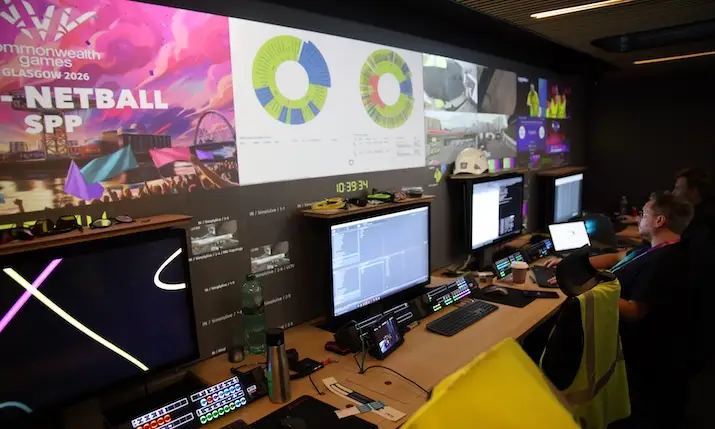
And innovation doesn’t always mean new. Actua took a “reuse rather than build” approach for the Broadcast Operations Centre. Using the existing modern facilities and services at BBC Pacific Quay removed the need for a conventional temporary international broadcast centre.
Host City: In the UK, TNT won the Commonwealth Sport broadcasting rights, so the BBC weren’t the primary rights holder this year. How did that change things?
Fitchie: The Games were shown in 166 territories worldwide, reaching an audience of 510 million globally, with more regions watching the Commonwealth Games than ever before. Here in the UK, TNT’s coverage captured every moment on every field of play for the first time, while offering new digital products such as multi-view, ensuring high-quality coverage was at the forefront of Glasgow 2026. TNT partnered with Channel 5 to provide free daily live coverage of the Games to UK audiences. TNT ensured streaming access for athletes, their families, and people across our network of venues and hotels. The way people consume sports media has changed significantly, and since the last Games online streaming has overtaken traditional free-to-air (FTA) viewing – a trend that is set to continue. It will be interesting to see how the UK market develops for the next Games in India.
Host City: Your colleague John Dundas gave an interesting presentation on “end-to-end connectivity” at Host City 2025. For those who missed it, what does that look like?
Fitchie: It’s about fully integrating all the systems in a venue while offering flexibility, reliability and full configurability. In Glasgow 2026, we delivered the Games Integrated Network, taking the concept to the next level. Built on Riedel’s DIVA+ network, it was a great success, enabling us to respond to late requests to add devices, such as those supporting features of the opening and closing ceremonies. Longines praised the system’s reliability in handling its data, video and audio signals. It also reduced infrastructure requirements and installation time at venues.
It’s all part of the same ecosystem: distribution, connectivity, and the digital journey of content.
Host City: What new tools are helping with planning and venue delivery?
Fitchie: Traditional tools for mapping, transport, Games Management Systems and incident management are becoming more integrated. They are adding timing functionality, GPS data, live updates and media content, while incorporating better data and beginning to use intelligent models to interpret it. This will help the right teams get the right information quickly and support more accurate planning decisions.
Host City: Cybersecurity concerns are growing across major events. How did you approach it – and where does AI fit in?
Fitchie: The concern grows every day, and rightly so.
We developed a proportionate response that evolved in line with the increasing risk profile. Our Security Operations Centre (SOC) worked closely with government partners – including the National Cyber Security Centre, the Scottish Cyber Coordination Centre (SC3) and Police Scotland – across corporate environments (our business systems), digital media, Games systems, and venue environments. It’s about understanding where the risks are and putting sensible controls around them, without stopping the event from functioning.
Naturally, there are concerns about using AI. The risks are both internal and external, spanning cybersecurity and data protection. Internally, there is the use of AI by staff – sanctioned or otherwise – and the risk that inadvertent activity could harm data and operations. Externally, malicious use is possible too. But AI is part of the picture on both sides of cybersecurity. At Glasgow 2026, we used Halcyon’s state-of-the-art AI tool to protect our systems against ransomware attacks. The recent PHP vulnerability shows how quickly things can move. Researchers used AI to help find the flaws and attempts to exploit them were seen before a fix had been published.
Host City: Is it only cyber attacks you need to worry about?
Fitchie: No – system resilience matters just as much. The recent Microsoft 365 outage wasn’t a cyber attack; Microsoft attributed it to a configuration change that exposed a bug. But it disrupted email, Teams and Copilot for organisations worldwide for more than a day. Events run to fixed timings and can’t simply be rescheduled when a platform goes down, so you need to know which services you depend on – including your AI tools, which often run on those same platforms – and have a plan for when they are unavailable.
Host City: How does all of this change the role of the CIO?
Fitchie: It will become increasingly important for a CIO to communicate clearly the impacts of AI alongside cybersecurity – to boards, partners and colleagues who aren’t technologists – in terms of risk, cost and benefit to the event. The technology is moving fast, and the decisions it raises can’t be left to the IT team alone.
Host City: Finally, what about sustainability?
Fitchie: Events have an increasing responsibility to deliver sustainably, and the environmental impact of AI data centres is currently well publicised. That is a legitimate consideration. It is another reason to use AI purposefully rather than for its own sake, to choose providers that are transparent about their environmental commitments, and to include environmental impact when you assess whether AI is giving you a good return.