Technology - Host City

Leading the content revolution

Host City 2019, the largest meeting of sports, business and cultural events, is delighted to be working with Strategic Partner and Silver Sponsor, the European Broadcasting Union (EBU) – the world’s leading alliance of public service media.

We spoke with Franck Choquard, Head of Content & Servicing at Eurovision Sport, which is a division of the EBU. With contracts with 25 Federations representing 20 sports, Eurovision Sport’s coverage equates to 30,000+ hours broadcast from 200+ events a year, 75 per cent of which feature women-only or mixed events – including 30 European Championships and 30 World Championships.


Host City: What do you see as the most pressing issues facing the broadcasting sector today?

Franck Choquard: As for any other actor within the entertainment industry, the overall broadcast sector is today facing a “digital revolution” in the way the various audiences are consuming content.

It is no longer possible to have one single linear TV approach to reach them all audiences,  we need to adapt our offering to the various communities we have – using the right platform (linear TV, OTT, social media etc…) with the right content.

More than ever, within this increasingly fragmented offering, it is important for national broadcasters to understand that editorial enrichment and targeted content delivery are key drivers for success.


Host City: How would you describe the main objectives of Eurovsion Sport’s digital strategy?

Franck Choquard: Our content strategy (we prefer this terminology than using digital), is based around  two pillars:

  • Offer European audiences free access to the best sporting content through our Members’ platforms, be it on linear TV or through innovative direct to fan (D2F) experiences – our Members being Europe’s leading public service media organisations
  • Be the premium partner for International Federations and host cities, not only guaranteeing the widest possible audience free-to-air in Europe but also generating new and innovative business models that serve to increase their event / content value


Host City: What kind of partnerships is Eurovision Sport establishing to develop this strategy?

Franck Choquard: We are building partnerships within three dimensions to achieve this strategy:

  1. With our Members and Federations, working together to offer a shared promotion strategy and building common D2F (direct-to-fan) ecosystems, to better engage audience and generate additional value to all stakeholders
  2. With technology partners (such as Dazzl or Livelike) allowing us (and our members) to enrich fans’ engagement within their digital ecosystem
  3. With some of the key actors within the FAANG (Facebook, Amazon, Apple, Netflix and Alphabet) to amplify our reach and coordinate our various stakeholders’ messages


Host City: What role do you think technology can play in reducing the footprint of major events?

Franck Choquard: Technology has a key role to play in this regard. The virtualisation and possibilities that technology can develop in the near future should enable productions to have only essential staff on site (editorial, producers, journalists) while engineers and technicians will be able to operate remotely, reducing the need for working areas, power, etc. Remote operation and virtualisation will also allow the delivery of more content to publishers for them to enrich the offering to their communities.


Host City: What are your expectations of Host City 2019?

Franck Choquard: I’m looking forward to fruitful exchanges with peers and colleagues from the International Federations and Organising Committees etc. that will be present; it looks like a great line-up. It will be exciting to further discuss how the integrative approach and working better together can enable us not only to have a better common strategy to increase the value of our events, but also to build sustainable models for the future.


The European Broadcasting Union is co-producing a session at Host City 2019 on Building better digital and sustainability strategies” at 12:10 on 27th November

Why the best minds meet face-to-face – and come to Glasgow

Aileen Crawford speaking at Host City 2018 (Photo: Michael Barr for Host City)

Host City is the largest meeting of cities and sports, business and cultural events, staged since 2015 in Glasgow where the world class conference and exhibition grows every year.

“Glasgow is incredibly proud to have been partners with Host City from the start,” says Aileen Crawford, ICCA Board Member and Head of Conventions at Glasgow Convention Bureau. “We look forward to the 2019 programme continuing the conversations and promoting best practice in the sector across the globe. Host City creates a special platform for discussion and collaboration and we are proud to be hosts of Host City 2019!”

The cost and benefits of hosting major sports events are widely discussed, but what is less well understood is the impact of business events. We asked Crawford why Glasgow is so focussed on generating a busy programme of business events.

“Glasgow Convention Bureau recognises that conferences are a vehicle for social and economic change,” she says.

“This benefit is not just economic; although the boost to the economy that comes from delegate spend is important, so too is the opportunity for local businesses to engage with a new audience and the benefit that comes to the academic community to raise their international profile among their peers.

“Glasgow recognises the importance the location plays in creating a positive environment for business to develop and the benefit the destination gains from the conference coming to our city.

 “Conferences bring the world’s best minds to the destination, aiding progress and advancing the future of the sector through meetings.


Secrets of success

One such academic event bringing the best minds to Glasgow is the European Society for Therapeutic Radiology & Oncology (ESTRO) Congress, whose Head of Innovation, Sven Bossu, is speaking at Host City 2019. The former Head of Sibos shares some advice for event owners looking to expand their properties.

“The key challenge is to have a clear view on the continuously changing expectations of the different audiences you serve – and adapting your value proposal accordingly,” he told Host City.

“When it comes to ESTRO, one of the key changes we’re currently implementing is to engage much more with the local community  and to actually co-create a project which has a tangible impact on cancer patients in the region the Congress will take place.

“This is not only in line with ESTRO’s mission, but it also creates a situation whereby the engagement with the community goes far beyond the five days of the event and whereby a tangible legacy is created.”

Event hosts also have their own secrets to success. Crawford shares a few of Glasgow’s with Host City.

“Glasgow is a successful and well-established business events city, welcoming more international delegates than any other UK city outside London,” she says.

“The city offers a wealth of free services to support conference organisers through the award-winning Glasgow Convention Bureau, making hosting a conference in the city an enjoyable and memorable experience. Glasgow is a city that understand Business Events, where the city partners, from the venues, academic institutions, hotel community and suppliers work together, focusing on the success of the meeting.

“Outside the business activities, Glasgow is a welcoming, vibrant and cultural city that offers a variety of engaging social venues that create a suitable back-drop for delegates to network. As the Gateway to Scotland, those delegates wishing to arrive early, or stay late can explore the ‘World’s Friendliest City’ in one of the ‘World’s Most Beautiful Countries’ (Rough Guides).”


Digital development

Digitalisation has indescribably transformed the ways in which people can connect and communicate with one another. Host City asked Bossu if he could envisage a time when digital communications replace face-to-face meetings.

“To be clear: digital will not replace face-to-face meeting,” he said. “However, digital offers a wide range of opportunities to enhance the customer experience – both before, during and after the event.

“Here are some basic examples: webinars will enable delegates to attain the same knowledge level before going to the event (allowing for better discussions); networking tools will allow delegates to connect more easily during the event (it is not always easy to connect with somebody in a 6,500 meeting!); and individualised outcome reports based on the behaviour of the delegate (which sessions did she/he attend, how does this link to his professional profile) allow the engagement to continue after the event.

Bossu is also looking forward to Host City 2019, the largest meeting of cities and sports, business and cultural events. “Personally, I’m really looking forward to hearing how meeting professionals from outside my knowledge zone are dealing with the same challenges I’m facing. And most importantly: looking forward to meeting lots of meeting aficionados.”

Host City 2019 takes place at the Technology & Innovation Centre in Glasgow on 26-27 November. Register here today.


SportAccord reveals first ‘Summit’ speaker line-up for Gold Coast

[Source: SportAccord] SportAccord has announced the first confirmed speakers for its Summit conference: The Future of Big Data and Analytics, taking place from 8 – 9 May 2019 at the Gold Coast Conference & Exhibition Centre, Queensland, Australia.

Nis Hatt, Managing Director of SportAccord commented:

“We have a strong line-up of speakers for this year’s SportAccord Summit sharing their views and expertise on why big data and analytics matter to sport, with sessions covering key touchpoints such as teams, athletes, brands, manufacturers and of course - fans.

“This year’s Summit places fan engagement and experiences at the heart of the matter and looks at the ways technology, content, media and entertainment interconnect.

“As technologies such as artificial intelligence, the internet of things, blockchain and others start to go mainstream, fans will be able to take a much more active role and feel richer for the experience.”

Global leaders from across the sporting industry are among the first speakers (in session order) confirmed for this year’s SportAccord Summit, including:

  • Deon Newman (Keynote), Chief Marketing Officer (CMO) and Vice President of Strategy, IBM Asia Pacific
  • Darren Birch, General Manager - Growth, Digital and Audiences, Australian Football League (AFL)
  • Nick Hockley, Chief Executive Officer, ICC T20 World Cup Australia 2020
  • Chris Nunn, Managing Director APAC, Futures Sport & Entertainment
  • Luke Bould, CCO & CMO, Football Federation Australia
  • Sally Hancock, Managing Partner, Y Sport
  • Matt Kamienski, Vice President and Executive Director - Presidents Cup, PGA TOUR
  • Andrew Reid, General Manager, TEG Analytics and TEG Insights
  • Barbara Kendall, Vice President, International Surfing Association (ISA), Non-Executive Director of ARRIA
  • Heinrich Zetlmayer, General Partner, Blockchain Valley Ventures (BVV)
  • Stephen Smith, CEO & Founder, Kitman Labs
  • Ian K. Partilla, Vice President - Head of Global Revenue, GumGum Sports 
  • Natalie Cook, 5 x Olympian and Gold Medallist – Australia, Beach Volleyball 

Delegates will also have the opportunity to discuss the Summit topics further with speakers and panellists on Day 2 during the five Summit Hub Breakout track sessions:

  • Big Data and Fan Engagement
  • Marketing and Customer Behaviour
  • Athlete/Player Performance via Wearable Technology, Big Data
  • Application of AI for International Federation (IF), Event, & Sponsor Performance
  • Blockchain Technology in Sport

 In addition to the SportAccord Summit, the full conference programme includes 4 other conference streams taking place across the week: LawAccord, CityAccord, MediaAccord and HealthAccord.

Delegates can register for SportAccord and attend conference sessions and the many networking opportunities offered within the Official Schedule.

To become an Exhibitor or Partner contact the sales team: sales@sportaccord.com or phone +41 21 612 3070. To register as a delegate and watch past SportAccord footage visit www.sportaccord.sport.

Follow developments and updates via Twitter @sportaccord using #SA2019, or keep up-to-date via LinkedIn and Facebook.

The futureproof venue is an innovation hub

Angela Ruggiero

The futureproof venue is a place that delivers total fan engagement and leverages technology to achieve this goal. Teams and properties need to think creatively about how to make their venues exciting today and relevant to their communities tomorrow.

To do this, questions around designing an experience that entices fans off the couch, keeps them safe, and engages them in a meaningful way should be considered early and often. Entertainment districts are rising to the challenge by creating spaces designed for multiple sports and events. Venues further strengthen their durability by enmeshing themselves in the city around them through mobility and connectivity initiatives.

If the fan is going to spend the time, money, and effort to get to the venue, they want to experience something they can’t be missed. They want to feel like they are part of something larger than themselves. Venues can deliver this by embracing their role as innovation hubs for emerging technology.


Acceleration of new technologies increases opportunity and risk

As a member of the PyeongChang Olympic Coordination Commission, our project began in 2011. In the 7-year span from kick-off to completion the world around us changed dramatically. Globally, internet access grew from 2 billion people in 2011 to 4 billion today.

This change was reflected in the 670 million people who watched the Games online, a 120 per cent increase from Sochi 2014. As applications on the Google Play store increased from 30,000 in 2010 to 3.5 million in 2018, mobile applications became the new way to access services such as ticketing and mobile ordering.

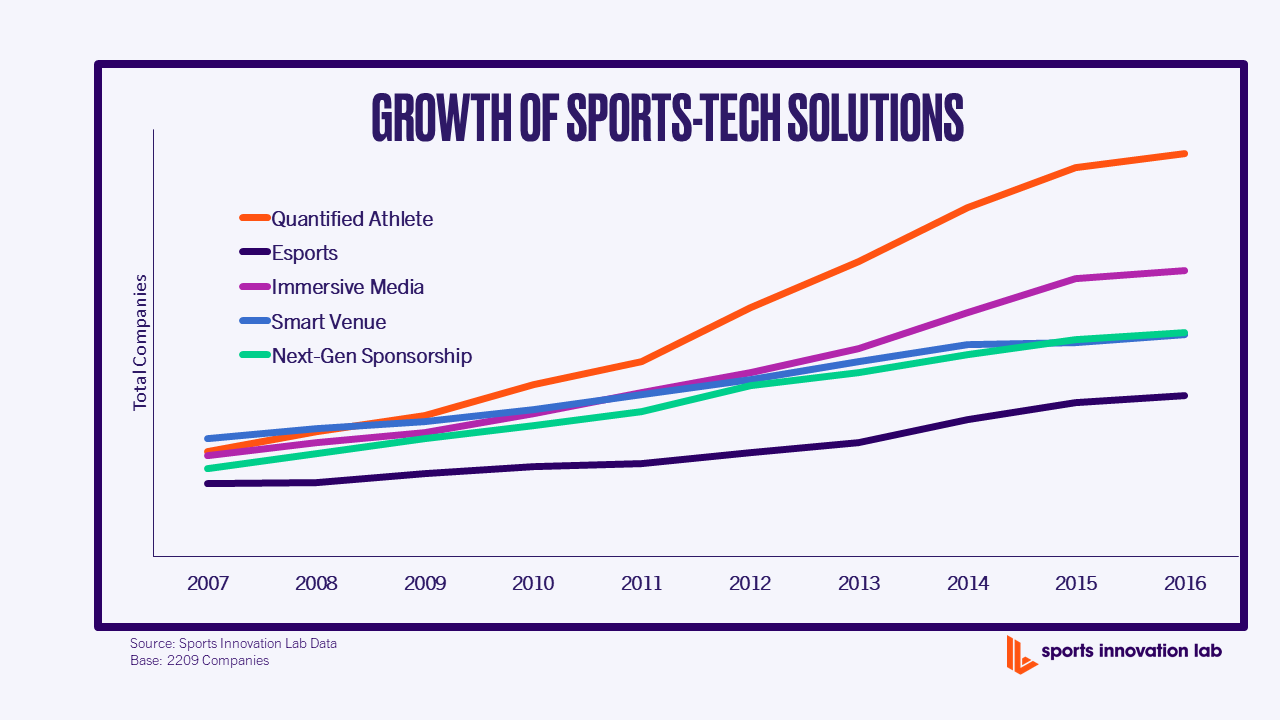
Behind the scenes, the evolution of cloud computing started to provide an easy to manage, scalable infrastructure resource which allowed companies to process large amounts of data. At the Sports Innovation Lab, we saw this change reflected in the proliferation of technology solutions. For the venues themselves, all of this change adds significant complexity but also provides opportunity to create differentiated and compelling technology-powered experiences that can wow fans.  

The rate of technology evolution presented challenges for the Organizing Committee of the Olympic Games (OCOG), as technology decisions are made three to five years before the first event begins. As available solutions changed between 2011 and 2018, so too did fan expectations: mobile ordering, contactless payments and high-speed connectivity became the norm (for social media and instant replays).

Despite these challenges, the 2018 Olympics was a presentation of today’s most exciting technologies, from 8K broadcasts and 5G connectivity to virtual reality. Staying abreast and ahead of the rapidly evolving technologies and fan expectations will be essential to the success of the Games in Tokyo, Beijing, Paris, and LA.


Smart venues rise to the challenge

To match pace with the rate of technology evolution, the futureproof venue must be an innovation hub where technology providers test their solutions. The pressure and opportunity for what we at the Sports Innovation Lab call a ‘Smart Venue’ continues to build. A Smart Venue removes hassle, creates memories and builds a technology platform for further innovation. We see a host of new solutions adding to the fan experience.

Technologies that remove hassle and create memories were on full display in PyeongChang. Many of the The Olympic Partners (TOPs) used the Games to demonstrate their technology capabilities on a global platform. I was able to see and hear about the future of 5G with Samsung, facial recognition with Alibaba, VR with Intel, self-driving cars with Toyota, robot assistants with Genie Talk, live athlete data used for performance and fan engagement from Omega, and contactless payments with Visa. Korea Telecom also developed a high-speed, low latency network to support mass video streaming and deliver Wi-Fi to 250,000 devices simultaneously. The Games provide one of the most visible platforms for global technology vendors, yet we also see new technologies being tested across venues on a daily basis.


Raising the innovation bar

In my final duties as a member of the International Olympic Committee, I awarded the 2018 USA Women’s Hockey Team their gold medals. Standing in the centre of the Gangneung Hockey Centre, the feeling was electric.

That energy traveled halfway around the world, where at 3 AM USA Hockey fans were watching via a 4K high-definition stream. This year’s Olympics demonstrated the opportunities and challenges live sports face in creating futureproof venues:

  • The live experience is incomparable. No substitute will ever match the in-person live experience at a venue.
  • The remote experience is drastically improving. For those who cannot experience an event live, there are a growing number of digital alternatives.

These two forces put an extreme amount of pressure on venues to make it easy and appealing for fans to attend live events, but it also creates a huge opportunity to improve access and engagement with sport. Venue operators will need to expand their innovation strategy for attracting foot-traffic and community value.

Some properties are rising to this challenge by adopting their identity as an innovation hub. The San Francisco 49ers have created an innovation centre to teach local school children about Science, Technology, Engineering, Art and Math at 49ersEDU. FC Barcelona has an Innovation lab to examine the future applications of athlete data.  The Green Bay Packers partnered with Microsoft to create the TitletownTech where digital solutions are developed for new market challenges.

Building innovation hubs inside venues for future events, Local Organizing Committees and venue owners/operators must look beyond blueprints and budgets to create innovation centres that increase the technology IQ of the local community, and ultimately, future fan engagement.

Blockchain expert Oliver Bussmann to deliver keynote at International Federation (IF) Forum 2018

[Source: SportAccord] Blockchain expert Oliver T Bussmann, CEO and Founder of Bussmann Advisory AG will deliver this year’s Keynote for the International Federation (IF) Forum due to take place from 5 – 7 November 2018 at the Hotel Royal Savoy in Lausanne, Switzerland.

The theme for the 12th edition of the IF Forum organised by SportAccord is entitled: Open Doors and Open Minds – New Tools for IFs. Delegates representing more than 100 international sports federations, associates and observer members from the Global Association of International Sports Federations (GAISF) will benefit from the insights shared by leading experts on subject matter such as cryptocurrency and blockchain technology.

Keynote speaker, Oliver Bussmann, also President of Crypto Valley Association and Former Group Chief Information Officer for UBS and SAP commented:

“Blockchain technology is a game changer and holds many possibilities for the world of sport. Entrepreneurs and industry leaders alike have started to explore potential use cases, looking into opportunities to crowdfund athletes with potential, track athlete performance and ways to boost fan engagement.”

In his keynote, Bussmann will share a brief introduction to blockchain technology and market trends, and highlight the potential for blockchain in sport with case study examples.

Further IF Forum conference and panel sessions will cover:

  • The ever-changing global landscape and its impact on sport
  • 5G in live sports broadcasting: how 5G technologies are expected to transform production and distribution
  • Event/Ticketing Pricing - Marketplace Trends and Success Stories
  • AI, Robotics, Facial Recognition - Changing how events are delivered and who helps deliver them!

The IF Forum provides a platform for international sports federations (both Olympic and non-Olympic) to tackle global matters related to the Sports Movement. The annual 3-day gathering is also limited to a small number of industry partners and gives them exclusive access to an authoritative networking environment and recognition as a supporter of the Sports Movement. This year’s industry partners are Eurosport, Guadalajara, JLT, Sports Nevada USA and Sociedad Peruana de Derecho Deportivo.

The IF Forum also receives the support of longstanding Host City Partners Lausanne and the Canton de Vaud, as well as the International Olympic Committee.

The final day of the IF Forum will include an eSports Workshop hosted by GAISF and the International Olympic Committee. For further details on the IF Forum visit: https://www.sportaccord.sport/if-forum

Red Bull Air Race technology brings sport and cities to the public

 The Ghost Plane augments the real camera picture with computer-generated content (Photo: Red Bull Air Race)

Since its first race in 2003, the Red Bull Air Race has been on a tireless quest to bring its unique aerial action into the ranks of the world’s most advanced sporting events. Fifteen years later, that mission has been achieved, and the sport’s development keeps advancing by leaps and bounds.

The Red Bull Air Race World Championship uses state-of-the-art technology not only to develop the sport itself – but also to provide an exceptional experience for spectators on the ground and viewers watching worldwide. Already, customization with the latest aviation technology has brought the powerful single-seat raceplanes to an unprecedented level of advancement, while high-tech timing and judging equipment, along with thoughtfully crafted revisions to the race format and rules, make the sport a can’t-look-away event. And the introduction of a second competition category, the Challenger Class, literally brings pilots up to speed, so that they inspire the best from the best when they join the top aviators at the World Championship level.

And then there are the technical innovations that take the sport even closer to the fans. At the forefront of technology, the Red Bull Air Race live TV product has helped the sport reach a massive audience and captivates a constantly expanding fan base around the globe, while mixed reality and virtual reality enable followers to share the experiences of their heroes.

Here are just a few examples of how the Red Bull Air Race has brought a new dimension to motorsport.


The unseen advantage: telemetry

One of the major factors in the technological progression of the Red Bull Air Race is telemetry data. What is telemetry? Very generally, the term refers to automated collection and transmission of data for monitoring purposes. Today, each of the raceplanes is equipped with more than 40 different sensors that report everything from airspeed and G force to critical engine measurements like RPM and fuel flow. This data allows teams to get insights on the best race lines and their own raceplane performance, which in turn inspire new training options and provide the basis for developing raceplane modifications and tactics through the racetrack. Telemetry data also makes judging more precise, enhances safety and, ultimately, improves the race performance of every team, for breathtakingly tight finishes in the riveting aerial showdowns.


Visibility on a major scale: live TV

Telemetry data is also an important contributor to the fascination of watching the race live on TV. Red Bull Air Race TV products reach a huge fan base around the world. Broadcast online and brought to 177 countries via broadcast partners, these TV productions open the motorsport to an ever-increasing base of dedicated fans, as well as new viewers who simultaneously discover the motorsport and the cities that host it from the comfort of their homes. In order to further enlarge these numbers and bring the action closer to audiences than ever, the TV production team utilizes state-of-the-art of technology and works with leading-edge collaborators to constantly develop and improve the viewing experience.

Perhaps the best example of how technology heightens audience engagement with the live TV shows is the Ghost Plane, a product based on telemetry data that has no equivalent in traditional sports broadcasting. While current conditions prohibit having raceplanes in the track simultaneously, the Red Bull Air Race can create that thrilling sensation through the use of a virtual plane – on live TV as well as on jumbo video screens onsite – that allows them to “see” two raceplanes flying head-to-head. The Ghost Plane is an augmented reality product that enhances the real camera picture with computer-generated content, developed specifically for the Red Bull Air Race. A positioning system, mounted in the fuselage of each raceplane, broadcasts the precise position of the aircraft to a ground base station, where an accurate graphic overlay of the flight is created in 3D. Then, when another competitor is racing in the track, the overlay is added, showing the position of the real raceplane and the virtual opponent in the track at any point during the run – in real time. The Ghost Plane was a hit with audiences when first introduced in 2015, and has evolved to be even more compelling in the seasons since.


A next-gen experience: holograms and virtual reality

In addition to developing its own technological prowess, Red Bull Air Race collaborates with leading technology companies, such as Microsoft and Google, to produce technical innovations that draw the fans right into the action to immerse themselves in the sport – even when they are at home. Two examples are the FlightDeck with HoloLens and the Red Bull Air Race LIVE VR experience on Daydream, both based on the live streaming of the data from the raceplanes. Each provides an exciting new viewing angle for understanding the sport, and each features the Red Bull Air Race host cities, meticulously incorporating the unique settings of these appealing global locations into the race environment. 

The Flight Deck allows fans to go right inside the race teams’ inner sanctum: This mixed reality app, developed in close collaboration with Microsoft and utilizing its HoloLens that brings holograms into the real world, gives users the chance to stand next to a virtual one-to-one scale Edge 540 raceplane as if they were in the hangar. Moreover, they can explore the rules of the sport in depth – from navigating a chicane to crossing the Finish Gate – and compare pilots in their head-to-head rounds.

The Red Bull Air Race LIVE VR experience uses real-time telemetry data straight from the pilot’s cockpit and re-creates the flight in a 360-degree virtual reality, so viewers can become fully immersed in a race from multiple angles and viewpoints, including the cockpit. Thanks to Google’s Daydream mobile platform for high-quality VR content, the combination of a Daydream View headset and any Daydream-ready smartphone transports viewers right into the racetrack. The VR experience is fuelled by live flight data like latitude, longitude, roll, pitch and airspeed to generate astounding perspectives and a real-dimensional, live visualization of the pilot’s view as the Air Gates and the local landmarks flash by at up to 370kmh, with users able to track the jaw-dropping speed and G Force. Marking a world first in data broadcasting on the platform, fans can dive into not just races that have already taken place (on demand), but also those happening live.


The future of motorsport today: with more to come

The ingenious, rapid-fire technology development of the Red Bull Air Race has brought the sport from audacious beginnings in 2003 to the official World Championship it is today, with 21 countries and an even larger number of cities featured as sensational hosts to its nearly 90 races so far. Whether fans are flocking to global destinations to see the Air Racing stars live, or engrossed by stunning scenes of the race via TV and augmented reality, technical wizardry brings them the future of motorsport today, piquing their interest in the race and everything that surrounds it. With more technical innovation in the works, that engagement is destined to become even broader and deeper with each season.


Erich Wolf, General Manager of Red Bull Air Race GmbH is speaking at Host City 2018 under the conference theme “The Future of Major Events”

The transformational power of host cities

Paul Bush OBE

Host City: The theme of Host City 2018 is “The Future of Major Events”. What do you think will be the single most important concern for event hosts and organisers in the next five to ten years?

Paul Bush: I believe the single most important concern for event hosts and organisers in the next five to ten years will be how major events contribute to government policy and help bring about long-term transformational change within society beyond just having an economic impact.

No longer can we hold events for events’ sake. They need to reflect the priorities of the wider community and ensure the benefit is felt across the board, not just amongst those immediately connected with the event.

It is about ensuring a 360-degree approach to the planning and delivery of events to ensure policy drivers such as health, education, transport and sustainability are reflected in the event’s overall aims and objectives.  

By taking this approach, it will in turn filter down into other key areas that will impact events going forward, including the integrity of the event, security and the role of technology in the viewing and delivery of events.


Host City: How are geopolitical trends and concerns over event governance impacting the distribution of future major events? Where in the world will future investment be strongest? What impact might Brexit have?

Paul Bush: As major events are often bid for and awarded years in advance, considerations of the ever-evolving geopolitical trends and event governance are part of the event planning and delivery process. It’s too early to say what the full impact of Brexit will be but as a global industry, events are well placed to respond to the changes that are likely to come given we are used to operating across national and international borders to deliver events, particularly around major sporting events.

Like everything, the funding landscape is also changing, with sponsorship and grants no longer simply about name rights and brand awareness. Therefore in the future, investment will be strongest where bids can successfully articulate the benefit of events that reflect the values and ambitions of rights holders and sponsors while aligning with government policies to deliver long-term transformational change.


Host City: What can event owners, organisers and hosts do to ensure major events become more financially and environmentally sustainable? How can hosting events create happier, healthier citizens?

Paul Bush: Again I think this comes back to taking a 360 degree approach to the planning and delivery of events. Aligning with government policy, particularly around, health, transport and infrastructure, will ensure major events are more financially and environmentally sustainable as well as helping create happier, healthier citizens.

As a society I think we are more aware of the impact of our carbon footprint so we’re looking for events to reflect value for money by minimise their environmental impact. Take for example the recent European Championships. There was limited capital infrastructure costs because we used existing venues from the Commonwealth Games in 2014. The only new venue built for the Championships was the BMX track, which is the first and only world championships and Olympic standard BMX track in Scotland and only the second in the UK, ensuring a legacy for the sport of BMX in Scotland.

We also want events to leave a lasting personal legacy on our citizens, whether that’s through signposting to activities that can improve both mental and physical health or providing opportunities to gain new skills and experiences through volunteering. So major events now have an important role to play within society beyond just providing an amazing spectacle for people to enjoy.


Host City: What are current trends telling us about the kind of content and formats that will be in demand in the future?

Paul Bush: Current trends are telling us we need to think about content and formats in quite a different way than we previously have. The old broadcast model is increasing becoming outdated and needs to evolve to ensure we continue to engage with fans. Fans want content that is personalised and accessible to them through a range of devices and mediums.

From an event delivery perspective, part of this trend means embracing and experimenting with new platforms – whether that be streaming live events, augmented reality or widening the fan engagement, on the platforms they are already using.

At the root, it is about moving away from thinking about digital as a channel and more as something that is core to the way we manage and run events.


Host City: What are your expectations of Host City 2018 and why should people attend?

Paul Bush: It is great to have Host City 2018 back in Glasgow and Scotland for the fourth consecutive year. I’m once again looking forward to the high calibre of speakers and delegates Host City attracts. This year’s agenda continues to push the industry to delve into the issues we’re facing and having meaningful debate round them.

It is also a great opportunity to network with colleagues from across the sporting, cultural and business events sector in a relaxed and friendly setting. So if you haven’t registered already, I highly recommend you do so now.


As Chairman of Host City 2018, Paul Bush OBE will be delivering the opening keynote address and speaking on the panel “Populations, politics and popularity stakes”. Register your attendance here

Losberger De Boer Appoints Rene Just as New CFO

Losberger De Boer, a leading provider of integrated temporary and semi-permanent space solutions, is pleased to announce the appointment of Rene Just as Chief Financial Officer of the company. He started with the company on April 3, 2018 and will succeed Carlo Dyckhoff from that date.

The Supervisory Board is grateful to Carlo Dyckhoff for his contribution and commitment in accompanying Losberger De Boer to where it stands today: a leading global player providing a wide range of products and services to many highly recognized customers.

Rene Just (Danish nationality, 50 years) has an extensive financial background from working for a broad variety of international companies. Most recently he held the position of CFO with Esvagt A/S, where he worked since 2016. Prior to this, Rene Just held senior management roles in Polygonvatro GmbH, Saxo Bank A/S and ISS. He started his career as controller with Colgate-Palmolive and has a Master of Science degree from Aarhus University.

The Supervisory Board is delighted to welcome Rene Just to Losberger De Boer and commented: “Rene brings with him significant international experience from Europe, Middle East and Asia and has an excellent track record of leading finance functions in various global companies. He has worked for listed and private equity owned companies and has shown his strength in professionalizing organisations, both from a financial as well as operational perspective.

"In the coming years, strong emphasis will be placed on the further integration of the various companies Losberger De Boer has acquired during the last years in order to fully benefit from all the available resources and capabilities. With the appointment of Rene, we have completed the Management Board to grow the company successfully and to strengthen its position as a leader in the market for temporary accommodations.”

About Losberger De Boer Group

Losberger De Boer is one of the globally leading providers of highly integrated temporary and semi-permanent space solutions, from sales to turnkey rental, with excellent customer satisfaction. Losberger De Boer is VCA**, ISO 9001-2015 and ISO 14001-2015 certified. Losberger De Boer is headquartered in Bad Rappenau, Germany, and operates 8 production facilities and 21 sales offices globally. Losberger De Boer employs 1200 staff worldwide. For more info please visit www.losbergerdeboer.com

Atos appointed Digital Media Provider to Glasgow 2018

[Source: Glasgow 2018] Already an Official Timing, Scoring and Results (TSR) Provider and Proud Supporter of the Championships, Atos will also help deliver a robust digital presence for the event following a competitive tendering process.

Atos will be working in partnership with Edinburgh-based agency Signal to design and develop the Glasgow 2018 and European Championships websites.

Atos will also be responsible for processing and distributing live results for all seven sports across Glasgow and Berlin and delivering live schedule and results pages to help sports fans and attendees access up-to-date information on the Championships.

A 2018 European Championships mobile application will also be created. Available from summer 2018, the ‘app’ will give fans access to medal tables, news and live schedules and results.

Atos and Signal previously combined their expertise and experience to ensure the digital success of the Glasgow 2014 Commonwealth Games.

To be staged every four years, the European Championships will combine the existing European Championships of Aquatics, Cycling, Gymnastics, Rowing and Triathlon, along with a new Golf Team Championships and Athletics staged in Berlin.

Glasgow 2018 Championships Director Colin Hartley, said: “There are now less than 200 days to go until the biggest sporting event since the Commonwealth Games comes to Glasgow, and Scotland. The first ever European Championships will be a new highlight in the global events calendar.

“Atos has an established track record in delivering digital services to large scale multi-sport events. The integrated online platforms they produce will allow people to keep up to date with the latest action and engage with the Championships, ensuring we deliver a must attend, must watch event.”

Gavin Thomson, Senior Vice President for Big Data and Security UK&I, Scotland, Ireland and Wales at Atos, said: “We are delighted to play a leading role in delivering the 2018 European Championships, having successfully provided leading edge IT solutions for the Commonwealth Games in Glasgow, and the Olympic and Paralympic Games for over 20 years.

“We warmly welcome the opportunity to be part of this new global sporting event and the digital transformation challenge of bringing the Championships to a multi-platform, digital-first worldwide audience. Our bespoke real-time service will enable fans to keep up to date with scores and results from anywhere in the world.”

As part of the inaugural European Championships in 2018 around 3,000 athletes will visit Scotland for six events - Aquatics, Cycling, Golf, Gymnastics, Rowing and Triathlon – while a further 1,500 athletes will compete in Berlin as part of the European Athletics Championships.

Attendances of up to 250,000 are expected at venues across Glasgow and Scotland, with a potential TV audience of up to 1.03billion.

SPORTELMonaco evolves with the sports media industry

SPORTEL says it is "the most influential business convention for the global sports media industry"

Host City: What are the main challenges and opportunities facing the sports broadcasting sector right now and how is SPORTELMonaco addressing these questions?

Laurent Puons: The main issue the industry faces these days is that the world is becoming smaller for everybody. Broadcasting is not only a territorial effort, but with new technologies that enable broadcasting and streaming via internet and social media, territorial and legal matters have become a major headache for rights owners. Broadcasters are facing more and more competition from OTT providers and classic broadcasters must face the reality of extinction, although many still don’t believe it.

The fact is however that audiences worldwide demand variety and freedom of choice. This, for the sport industry is of course a great development and opportunity! The more fans can be rounded up across the globe to see just one sports event, the greater the opportunity to build brand, event and merchandise deals in multiple territories globally.

It’s impossible to cram all issues into one conference, there is simply not enough time to address all at once, but during SPORTELMonaco we can definitively address issues such as OTT, social media and new developments in Asia, which will lead up to our next spring convention SPORTELAsia 2018, in Singapore.


Host City: SPORTELMonaco is now described as “The World Sports Marketing & Media Convention”, reflecting a wider remit than the traditional focus on broadcasting. Why have you changed focus in this way?

Laurent Puons: We haven’t changed our focus, rather evolved “with” the industry, as more and more technologies appear every year that enable events, productions and broadcasters to deliver more sports content to viewers and fans on a massive variety of platforms and change the content business significantly. Also this part of the industry is a lot more influenced by marketing objectives of agencies, federations and brands. In result it is of course a necessary and natural progression of SPORTEL to provide these business opportunities to our community. No other event, but SPORTEL can realistically provide this wide variety.


3/ How can SPORTELMonaco help rights holders to find new ways to reach audiences?

Laurent Puons: For close to 30 years, SPORTEL has always been part of the industry development. Our team knows the industry personally, which is why we never address them as clients but our “community”. We have open and direct dialogues, built on years of trust and know how, understand which companies do what and know what will happen before most in the industry do. This gives us the advantage to prepare and build real business opportunities for the community.

SPORTEL truly is on the frontline of the industry and together with international decision makers we are in the position to see the future of our industry and react accordingly.

Pages