IAEH - Host City

ASOIF partners with IAEH to measure the value of major sports events

IAEH Chair Susan Sawbridge (on the right) pictured speaking at Host City with (L-R) Eva Szanto, CEO, FINA World Championships, IAEH Director Iain Edmondson, and Tracy Bury, World Confederation for Physical Therapy

[Source: IAEH] ASOIF signed a Memorandum of Understanding with the International Association of Event Hosts (IAEH), aimed at jointly establishing appropriate "common event impact measures" which will be widely accepted and can be applied to all major sports events.

Common data standards for measuring tangible impacts of major sport events enable event stakeholders to cost-effectively assess the value of events and their return on investment. They also facilitate the comparison between events within the same sport over time as well as across different sports. Impacts to be measured include economic, reputational, social and environmental. 

 The common measures will be finalised in the second half of 2021. ASOIF and IAEH will then jointly endorse recommendations, guidance and tools to help their members implement the common event impact language. As a next step, both organisations will collaborate to obtain additional support, research and funding from third-party organisations to enhance the tools available for robust measurements of impacts currently regarded as intangible. 

ASOIF Executive Director Andrew Ryan will join IAEH members at the 2021 IAEH AGM on 15th June to speak about the landscape of IF events in the coming years and introduce the MoU signed between the associations. 

The Chair of IAEH, Susan Sawbridge, said of the partnership with ASOIF: “The IAEH exists, in part, for event hosts to share knowledge and generate greater long term social and economic benefits from hosting events. A common view of event impact measurement standards is extremely helpful if we are to do this well, building a shared language for understanding and growing international events as they move from destination to destination.”

The IAEH provides a platform for ‘not-for-profit’ event hosts to collaborate on generating the best possible value from hosting major sporting and cultural events. IAEH members can learn from successes and challenges in delivering major events, sharing knowledge and generating greater long term social and economic benefits from hosting events.

ASOIF Executive Director Andrew Ryan commented: “This is a significant step for the project’s progress, as ASOIF members and IAEH members, the International Federations and City Hosts, represent the key stakeholders in major sports event delivery and hosting.”

ASOIF began to facilitate and support better impact evaluation of its member federations’ major events in 2017.  This was thorough impact evaluations made by an external provider. In light of the experience and the outcomes identified, ASOIF decided to encourage and initiate the development of common event impact measurement standards across major sports events.  

Click here to read the full text of the MoU.

Watch the Host City 2020 Workshop: Event Impact Measures, ASOIF & IAEH here - and register for Host City Americas to join the next workshop on Hosting Events with International Federations. 

Hosts get set for return of major events in 2021

[Source: IAEH] The International Association of Event Hosts has published the results of a survey conducted to understand the impacts of the pandemic on members’ events in 2021. IAEH members in Asia, Australia/New Zealand, Middle East, Europe and North America participated in the survey. The results show that the impacts and responses differ according to geographic location.

Most host organisations are expecting and planning to return to major events in 2021

o             Two thirds of members responding currently have cancelled or postponed events no later than September 2021, and only 17% currently have cancelled or postponed events in 2022.

Plans for ‘stadium’ events to re-commence

o             Two thirds of host organisations have already or are planning to allow’ stadium’ events in 2021.

o             In Australia and New Zealand ‘stadium’ events have either already re-commenced or are planned to re-commence with full capacity in April 2021.

o             In Asia, Europe and North America, 25% have plans for ‘stadium’ events to re-commence with full capacity but only late in 2021 or in 2022.

o             24% of all respondents have no current plan date for ‘stadium’ events to re-commence. The majority of these are in Europe.

Restrictions

o             For members hosting ‘stadium’ events with restrictions, the limits that apply are of no more than 50% capacity.

o             Some members also reported that restrictions are being imposed according to social distancing rules rather than percentage of capacity.

Measures adopted to support the events industry

o             The majority of host organisations have actively put in place measures to support the events industry. 50% of organisations reported event-specific initiatives in addition to general national government support.

o             Measures are similar across regions including mainly financial aid such as wage subsidy, interest free loans, tax relief, emergency funding, and reimbursement packages.

o             Members rated the effectiveness of these measures were higher in Australia, New Zealand, Asia and Middle East (7 out of 10) than in Europe and North America (5.5 out of 10).

Guidance for staging major events varies across the world

o             50% of members responding are using external resources - some based on resources from the World Health Organisation, others based on national or regional advice.

o             25% of members responding don't yet have any guidance in place for major events to go ahead.

The survey was completed by 24 IAEH member organisations between 8th and 29th March 2021.  A similar survey was conducted by the IAEH in May 2020. Comparing the results, a significant difference is on planning for ‘stadium’ events to re-commence.

In 2020, the level of uncertainty was much higher and the large majority (80%) of host organisations reported that there was no planning date for ‘stadium’ events with an audience to re-commence. Whereas in 2021, 76% answered that there is a plan date, with specific restrictions or full capacity.

The support measures also developed significantly since May 2020 and now the majority of host organisations have actively put in place measures to support the events industry.

IAEH survey: COVID-19 effect on events hosting sector

Cheltenham 2020

[Source: IAEH] Aiming to understand the impacts of the COVID-19 pandemic to event hosts, the IAEH surveyed its 41 member organisations across 22 countries from Asia, Middle East, Europe and the Americas

Survey feedback showed;

  • • Significant impact of cancellations and postponement across the world
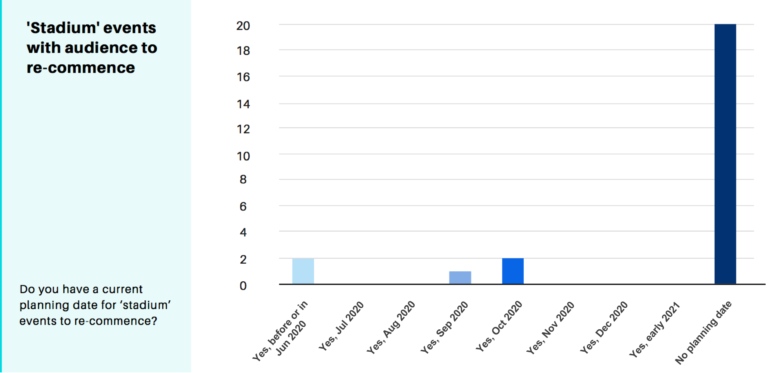
  • • 80% of members don’t yet have a date for when they expect ‘stadium’ events with an audience to re-commence
  • • Only 3 countries, and none in Europe and the Americas, already have guidance in place for staging spectator events in future
  • • The first events to return are expected to be;
    • – Professional sports/arts events behind closed doors
    • – Small local events with limited attendance
    • – Festivals and events which integrate an online presence
  • • Event hosts are actively supporting the event sector, through funding, multi-stakeholder collaboration and digital innovation

Continuing this discussion on the impacts of COVID-19, the IAEH will be hosting a free virtual ’round table’ webinar on response strategies. IAEH members from Canada, United States, Scotland, Japan and New Zealand will be discussing  the current status and mid to long term solutions to mitigate the damage while supporting the recovery of the industry in the months and years ahead. (Register and join on 10th June at noon (BST)).

The events industry has been heavily impacted by the COVID-19 pandemic. Sporting, cultural and business events have been banned around the world to avoid further spreading of the coronavirus. IAEH members, who are not-for-profit organisations that represent cities, regions and countries that host major events, have been dealing with many postponements and cancellations, and working to mitigate the damages to the whole industry.


THE IMPACT

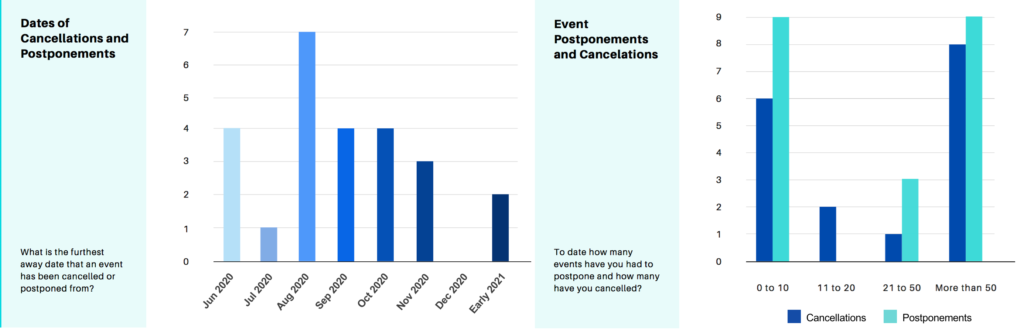
Postponements and cancellations
The damage caused by event postponements and cancellations varies according to the location and size of the host organisation but all have been affected. Members reported that events scheduled to take place even after this summer (Northern Hemisphere) and, in some cases, all the way until early 2021 have been postponed or cancelled.


CHALLENGES AND LESSONS LEARNED

Participants were asked to list the biggest challenges imposed by the COVID-19 crisis and some positive lessons learned from these difficult times.

The three biggest challenges created by COVID-19 as reported by IAEH members are:

  1. 1. The economic impacts of event postponements and cancellations, including job losses and expected future cost increases due to social distancing requirements.
  2. 2. The uncertainty about the short and long-term future, including current and future travel restrictions, making planning very difficult.
  3. 3. The shift in priorities of both individuals and organisations during the current crisis and in the post-pandemic world.

Lessons are certainly being learned through dealing with the COVID-19 crisis. When asked about anything positive they could take from this experience, members highlighted the following:

  1. 1. New ways of working and communicating that can have a positive impact not only reducing organisations’ expenses but also to the environment (e.g. positive climate effects with less travel).
  2. 2. Creative and innovative solutions that have been used to address the problems caused by the pandemic but that can be carried forward and applied to the industry post-pandemic. This includes a wider use of technology and the digitisation of events.
  3. 3. New and strengthened collaboration between local/national stakeholders, the results of which include revision of contracts, particularly force majeure clauses and insurance policy improvements.


THE RECOVERY

WHEN ARE EVENTS RESUMING?

This survey’s results also show the uncertainty of the situation which makes planning for the future a big challenge. The large majority (80%) of members who participated in the survey reported that there is no planning date for ‘stadium’ events with an audience to re-commence.

Different kinds of events may resume at different times. Members reported that the first events to return are likely to be:

  1. 1. Small outdoor events where physical distancing rules can be respected.
  2. 2. Professional sports or performing arts without an audience. Domestic competitions of individual sports such as golf, tennis and BMX could also be allowed soon.
  3. 3. Cultural, business and even sport events that are able to go online. Event digitalisation is a new trend and proving to be a valuable solution at least until social distancing rules are fully eased.


NEW SAFETY MEASURES AND PROTOCOLS

When events and larger gatherings are to be allowed again, new guidance on safety measures and protocols, such as hygiene standards and health checking, will need to be implemented. Survey participants highlighted the work of their governments in defining the new norms and reported that these had not yet been published at that time. Only 3 countries, and none in Europe or the Americas, have measures already in place, but those are being continuously updated to reflect the current situation in the specific location.


NEW WAYS OF SUPPORTING THE INDUSTRY

IAEH members indicated that they have established new ways of supporting the event industry in response to COVID-19. This included:

  1. 1. Funding to support event organisers or organisations servicing the events industry.
  2. 2. Initiatives to support events to go digital place including local/national media campaigns to generate engagement and alternative sources of revenue from virtual events.
  3. 3. Cooperation between stakeholders to access local/national support initiatives seems critical. Members reported that new associations and platforms are being created to address the crisis and guarantee that the response is well coordinated.

IAEH members also reported a shift in event support objectives from focusing on events that drive visitation to focusing on events that primarily drive community benefits and showcasing opportunities

For this survey’s technical information and questions/comments please email admin@eventhosts.org.
The full results of the 2020 IAEH Members’ Survey is available for members only at 
www.eventhosts.org/resources/.

Susan Sawbridge joins New Zealand Major Events to lead new prospecting unit

Suzan Sawbridge and Devorah Blumberg of New Zealand Major Events

Susan Sawbridge has joined the New Zealand Major Events team at the Ministry of Business, Innovation and Employment to head up a new unit focused on event prospecting.

The New Zealand government has established a new Major Event Prospecting Secretariat and independent panel, which will see the country’s government agencies working together to drive a proactive major event prospecting programme.

Led by Susan Sawbridge and housed within the Ministry of Business, Innovation and Employment, the Major Events Prospecting Secretariat will work closely with central government agencies, local government and sector bodies to ensure New Zealand continues to attract and develop significant international events. 

Susan previously managed event prospecting and bidding for the city of Auckland.

 “This is a really exciting time for us and we are incredibly fortunate to have secured Susan’s talent to champion the government’s approach to prospecting,” said Devorah Blumberg, Manager of New Zealand Major Events.

Susan Sawbridge said, “New Zealand’s major events capability is now very well established, so it’s a perfect opportunity to move prospecting into an even more collaborative and strategic space – both from our perspective and also for events rights holders.”

New Zealand Major Events is a member of the International Association of Event Hosts and a participant in Host City 2017.

International Association of Events Hosts incorporated as charity

IAEH members met at SportAccord 2017

The International Association of Event Hosts (IAEH) came together from across the globe for the annual IAEH Forum at SportAccord Convention in Aarhus, Denmark yesterday to discuss and vote on the structure of the organisation.

Representatives from 24 of the 34 member organisations voted on the incorporation of the IAEH as a charity under English law, overseen by the Charities Commission in England. The establishment of a Charitable Incorporated Organisation was unanimously approved.

IAEH founding members Iain Edmondson from London & Partners and Devorah Blumberg from New Zealand Major Events said that the vote is a milestone in the association’s development. 

Edmondson said: "The agreement from members to incorporate the IAEH is a huge step forward for us as an association. It signals that we are globally aligned in our thinking as event hosts. The formalisation of the association provides a platform for growth as the global network for sharing our knowledge".

Blumberg went on to say: "The incorporation of the association will also provide members with an international shared voice for hosts of major events. We invite cities, regions and countries that aren't already involved in the network to join now and enjoy the benefits of working with peers on a global scale.

The membership discussed nine priority areas for knowledge sharing and the calendar of meetings for the period ahead. Of the priority areas for discussion the group identified a clear front runner of interest to event hosts - measuring economic and social benefits. Other subjects which were front of mind for members included attracting visiting tourists and alternative sources of funding. Members will discuss these priority areas in greater depth as part of the IAEH work programme.

Throughout 2017 IAEH members will have four more opportunities to meet ahead of the Annual Forum in 2018 which is usually timed with SportAccord Convention. IAEH members also met at Host City 2016 in Glasgow. Members see these meetings as valuable opportunities for sharing experiences from hosting major events with a focus on overcoming challenges and measuring success.

Glasgow, Gothenburg, Malaysia and Skåne join International Association of Event Hosts

Destination marketing organisations from Sweden, Scotland and Malaysia have joined International Association of Event Hosts (IAEH).

Malaysia Major Events and Event in Skåne joined in the first week of January 2017, with Göteborg & Co and Glasgow Life having joined in November 2016.

The organisation now has 23 members since its formal launch in April 2016.

Malaysia Major Events was established to identify, promote, facilitate as well as support viable international events to be staged in Malaysia, the organisation is a division of Malaysia Convention & Exhibition Bureau and it is based in Kuala Lumpur.

Malaysia has a packed programme of sports, business and entertainment events. Events scheduled for the first three months of 2017 include the Viper Challenge Series, the Wonderful World of Disney on Ice (100 year celebration), Powerman Duathlon Asia Championships, WTA - Malaysia Open, Miri Country Music Fest and Bryan Adams Get Up Tour.

Skåne is the southernmost county in Sweden. Based in the city of Malmö, Event in Skåne works to make Skåne a leading venue for top Swedish and international events.

The New York Times ranked Skåne as one of the top ten places in the world to visit in 2016. The region regularly hosts world and European championships and several other major events.

Gothenburg is Sweden's second largest city, with 540,000 inhabitants, located on the west coast. Despite its small size, it hosts an impressive list of international events, a success it puts down to close collaboration within the city's event industry, infrastructure for hosting events and bold, creative and professional organisers.

Glasgow Life, represented by Ian Hooper, joined the Association during Host City 2016 in November. Glasgow Life’s vision is to inspire citizens and visitors to lead richer and more active lives through culture, sport and learning.

Glasgow’s track record in staging major events is enviable, from multi-sports events like the 2014 Commonwealth Games and 2018 European Championships and individual sports events like such as 2015 World Gymnastics, to important major conferences such as Host City.

The IAEH is a worldwide organisation for representatives of international destinations to collaborate together to generate the best possible value from hosting major sporting and cultural events, and provide a voice for ‘not for profit’ hosts of events.

IAEH provides a platform for members to learn from the successes and challenges of major events, share knowledge and generate greater long term social and economic benefits from hosting events.

IAEH meets at the most important meetings of the major events sector including Host City and SportAccord Global Convention.

Host City, the largest meeting of cities and sports, business and cultural events, will take place again in Glasgow in November 2017.